


Fresh-water storage tank 300 litres with 2 smooth pipe heat exchangers

OEG no.: 516008294
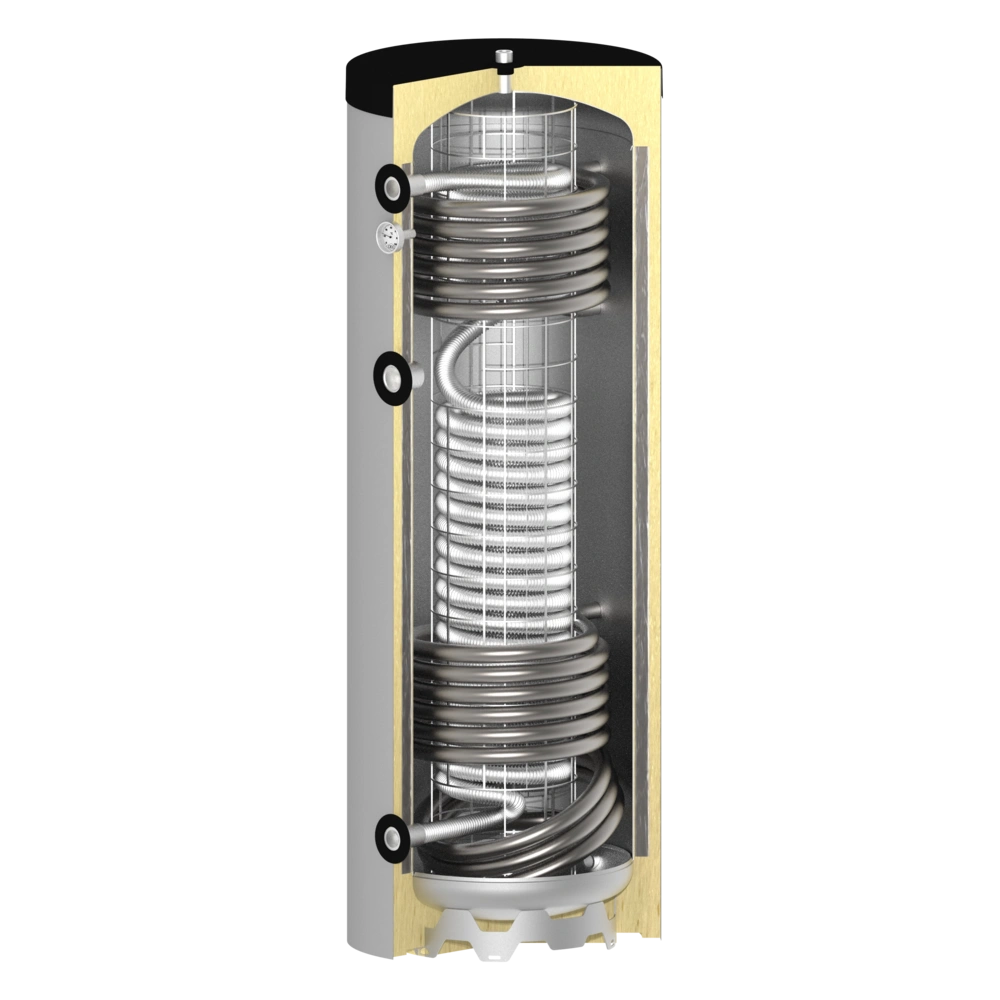
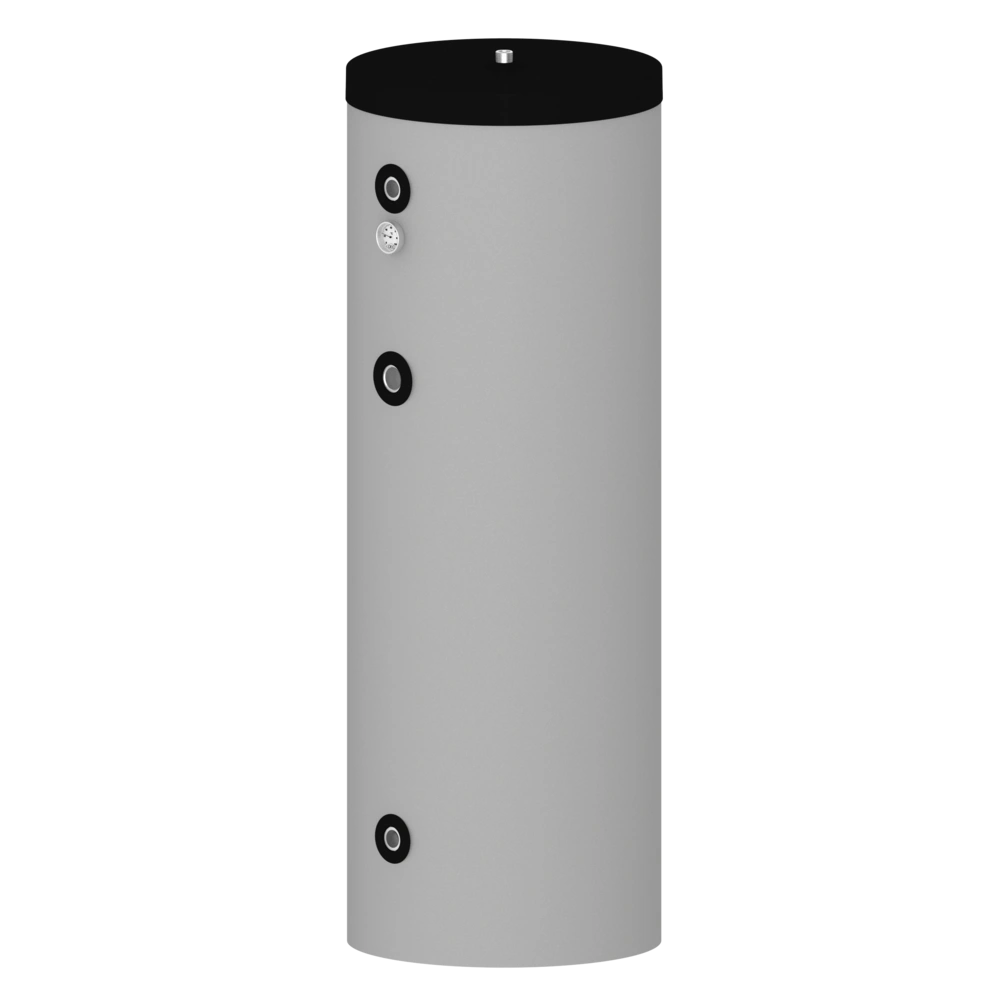
Fresh water storage tank for highest demands on drinking water hygiene and energy efficiency.
The structure of fresh water storage tanks differs fundamentally from conventional, large-volume domestic hot water storage tanks...

Delivery by forwarding agency


High Quality


Clean fresh water generation in corrugated stainless steel pipe with flow heater principle


10-year warranty


TÜV Rheinland

Fresh water storage tank for highest demands on drinking water hygiene and energy efficiency.
The structure of fresh water storage tanks differs fundamentally from conventional, large-volume domestic hot water storage tanks. A built-in corrugated stainless steel pipe separates the drinking water from the heating water and also serves as a high-performance heat exchanger. This combines the advantages of a buffer storage tank with those of an instantaneous water heater.
The heating water serves as actual heat storage while the drinking water passes through the corrugated stainless steel pipe only if required, and this ensures a domestic water heating that is legionella-safe. You do not need a legionella protection programme in the control unit. At all times, the consumer is provided with hygienically perfect, fresh water at the desired temperature.
The two auxiliary smooth tube heat exchangers give your customer the option of integrating more heat generators at any time and feeding their energy into the fresh water storage tank.
For more information see Downloads
| OEG no. | 516008294 |
| Tank capacity [litres]: | 300 |
| Operating mode: | multivalent |
| Installation type: | Vertical storage tank |
| Manufacturer | OEG |
| Brand | Pure+ |
| Energy efficiency class | A+ |
| ErP-Label |
|
| Notes |
Delivery by forwarding agency
High Quality
Clean fresh water generation in corrugated stainless steel pipe with flow heater principle
10-year warranty
TÜV Rheinland
|
| Customs tariff number | 84191900 |
General
| Colour: | silver |
| Insulation according to DIN 4102-1 Fire Protection Class B2: | solid foamed insulation |
| Weight [kg]: | 110 |
| Total height including insulation [mm]: | 1750 |
| Diameter with insulation [mm]: | 610 |
| Tilt height [mm]: | 1830 |
| Energy efficiency class according to EU regulation no. 812/2013: | A+ |
| Heat retaining loss according to EN 12897 [W]: | 36 |
| Heat losses in stand-by mode according to DIN 12897 [kW/h / 24 h]: | 0,864 |
| Output capacity (45°C) [l]: | 175 |
| Performance indicator NL following DIN 4708: | 1,60 |
| TÜV certificate ID: | 0000080330 |
| Real volume according to EN 12897 [l]: | 294 |
| pmax Tank [bar]: | 3 |
| tmax Tank [°C]: | 95 |
| tmin Tank [°C]: | 20 |
| DHW heat exchanger area [m²]: | 4,40 |
| DHW heat exchanger volume [l]: | 19,30 |
| pmax DHW heat exchanger [bar]: | 6 |
| tmax DHW heat exchanger [°C]: | 95 |
| Smooth-pipe heat exchanger [number]: | 2 |
| Smooth-pipe heat exchanger area bottom [m²]: | 1,15 |
| Smooth-pipe heat exchanger area top [m²]: | 0,77 |
| Smooth-pipe heat exchanger volume bottom: | 7,50 |
| Smooth-pipe heat exchanger volume top: | 5,05 |
| pmax Smooth-pipe heat exchanger [bar]: | 10 |
| tmax Smooth-pipe heat exchanger [°C]: | 130 |
| Connection layout: | 180° |
| Connection sensor [Ø mm / terminal]: | 6 mm |
| Connection cold / hot water: | Rp 1 1/4" |
| Connection heat generator [thread]: | R 1" |
| Connection heat exchanger [thread]: | Rp 1" |
| Connection heating element [thread]: | Rp 1 1/2" |
| Max. immersion depth of screw-in heater [mm]: | 500 |

Question
(Tank capacity [litres]: 800 | Colour: White)
Bei dem Speicher (Artikel 516008126) wird im Datenblatt ein Warmhalteverlust von 51 Watt angegeben. Ist dies richtig? Wie wird dies erreicht? Der Speicher hat die üblichen 110 mm Dämmung. Welches Dämmmaterial? Sind für nicht benötigte Anschlüsse, Dämmkappen verfügbar?
Answer OEG:
Es erfordert den neusten Stand der Technik eine A+ Dämmung mit ca. 100mm Dicke anbieten zu können.
Wir verwenden dafür extrem gut isolierende Vakuumpaneele innerhalb von Polyurethan-Hartschaum-Segmenten.
Die thermische Dämmleistung unserer 100mm dicken Segmentisolierungen entspricht einer ca. 640mm Faser- oder Schaumdämmung.
Für nicht benötigte Anschlüsse sind leider derzeit noch keine Dämmkappen verfügbar.
Wir arbeiten jedoch bereits an der Entwicklung. Passende Dämmkappen werden voraussichtlich in der ersten Jahreshälfte 2019 verfügbar sein.
Question
(Tank capacity [litres]: 800 | Colour: White)
Bjr.Quelle est la constante de refroidissement ? Quelle est la garantie de l'appareil ? Est-ce que l'appareil accepte un systéme anti-tartre AQUABION ?
Answer OEG:
Constante de refroidissement: 2,8 kW/24h, 117 watts, selon la norme EN 12897.
La garantie est de 10 ans sur tous les ballons OEG.
Le ballon accepte un système anti-tartre AQUABION.
Question
(Tank capacity [litres]: 800 | Colour: White)
Deze verswaterboiler hefet 2 spiralen. Zijn beide spiralen in RVS?
Answer OEG:
Deze boiler heeft in totaal 3 wisselaars.
2 stalen buiswisselaars voor gesloten circuits (verwarmingscircuit, Solarcircuit of ander warmtebronnen in een gesloten circuit)
De boiler is standaard uitgerust met 1 RVS wisselaar voor het tapwater (zuurstofrijk)
De opwarming gaat via het doorstroomprincipe waardoor legionella geen kans krijgt en er minimaal onderhoud nodig is bij dit type boiler.
OEG produceert de boilers in eigen fabriek en kan op aanvraag een boiler naar wens produceren (dus ook met meerdere RVS wisselaars)
Neem hiervoor contact op met onze afdeling verkoop via: [email protected]
Question
(Tank capacity [litres]: 500 | Colour: Silver)
Beste, Is dit de juiste boiler voor: 1 Verswater warmtewisselaar , 1 wisselaar voor zonnesysteem , 1 wisselaar voor gescheiden circuit vloerverwarming , 1 algemene aansluiting voor bijverwarming van de 500 liter inhoud via cv ketel. 1 ingang voor elektrische weerstand. Alvast bedankt.
Answer OEG:
Ja, de boiler is geschikt voor de door u omschreven toepassing
Question
(Tank capacity [litres]: 800 | Colour: White)
Bonjour, Merci me communiquer le débit instantané (ECS) à 45 °C (non pas la quantité globale soutirable ! Merci Philippe CALIMAX
Answer OEG:
Les débits indiqués se réfèrent toujours aux 10 premières minutes.
Réservoir de stockage à 65 °C, soutirage à 45 °C, 571 litres.
Au-delà, le débit possible dépend fortement de la capacité de réchauffage.
La perte de charge à ce débit est d'environ 0,5 bar.
Question
(Tank capacity [litres]: 800 | Colour: White)
Bonjour, Merci me communiquer le débit Instantané ECS à 45 °C (non pas la quantité ttle soutirée...! Merci Philippe CALIMAX
Answer OEG:
Les débits indiqués se réfèrent toujours aux 10 premières minutes.
Réservoir de stockage à 65 °C, soutirage à 45 °C, 457 litres.
Au-delà, le débit possible dépend fortement de la capacité de réchauffage.
La perte de charge à ce débit est d'environ 0,5 bar.
Question
(Tank capacity [litres]: 800 | Colour: White)
Beste, Ik kom graag terug op mijn vraag over het bulkvermogen. Zou u mij kunnen voorzien van: Een grafiek of tabel waarin het bulkvermogen is weergegeven voor verschillende afmetingen (bijvoorbeeld 50/45/10 bij 300, 400, 500) Of een formule waarmee ik zelf het bulkvermogen kan berekenen voor de gewenste afmetingen. Ik ben momenteel bezig met een project waarbij ik een warmtepomp op laagtemperatuur gebruik. Omdat ik nog twijfel over het benodigde totaal volume, zou deze informatie mij zeer helpen bij het maken van de juiste keuze.
Answer OEG:
Voor de opslagtanks specificeren wij de bulkcapaciteit van 45 °C (opslagtank 65 °C, koud water 10 °C, geen naverwarming), wordt dat bedoeld met volumetrisch vermogen of wilt u iets anders?
Question
(Tank capacity [litres]: 800 | Colour: White)
convient il pour une installation solaire thermique
Answer OEG:
oui
Question
(Tank capacity [litres]: 500 | Colour: Silver)
bonjour, ce produit est il utilisable en auto vidangeable?
Answer OEG:
non le ballon n´est pas adapté pour cela
Question
(Tank capacity [litres]: 500 | Colour: Silver)
Beste, zijn volgende producten compatibel met deze vers waterboiler? elektrische weerstand nr. 517900193 / regelaar nr. 517900420 / thermometer nr. 310700902. Gelieve te corrigeren indien vereist aub. Heb ik extra (messing) draad-reducties of hulzen nodig om deze onderdelen in de boiler te monteren? Zo ja, graag deze info bijvoegen. Dank bij voorbaat, vriendelijke groeten, Ludo Leys
Answer OEG:
Screw-in heater 4.5 kW is beter geschikt als elektrisch verwarmingselement en de thermostaat Bimetal dial thermometer 0-120°C 45 mm sensor with 63 mm case wordt meegeleverd, maar Thermometer Ø 80 mm bimetal 0 - 120 °C 50 mm sleeve Ø 6 mm zou ook geschikt zijn.
Controller and limiter for immersion heater ASKOHEAT is een reserveonderdeel voor een elektrisch verwarmingselement en is daarom niet absoluut noodzakelijk.
Question
(Tank capacity [litres]: 500 | Colour: Silver)
Halo, Verswaterboiler is dit het zelfde als buffervat? is het mogelijk hier een aparte elektrische weerstand hier bij in te plaatsen? alvast bedankt.
Answer OEG:
Een buffervat is alleen geschikt voor verwarmingswater in een gesloten systeem.
Een verswaterboiler is gevuld met verwarmingswater en heeft een inox wisselaar waar tapwater mee wordt verwarmd in het doorstroomprincipe.
Zowel een buffervat als een verswaterboiler kunnen aanvullend worden uitgerust met 1 of 2 buiswarmtewisselaars voor een of meerdere warmtebronnen.
Kijk voor meer informatie op onze site bij het betreffende product onder "alle productinformarie" en "downloads" of neem telefonisch contact op met onze verkoop. Tel. 0800 1 5693 (gratis servicenummer)
Question
(Tank capacity [litres]: 800 | Colour: White)
quels sont les puissances des échangeurs? où peut-on trouver la documentation technique? vous donnez la surface mais pas la puissance... beaucoup de questions type "combien de L/min" qui ne sont que des calculs de puissance (P=Qx1,163xDT) hors il manque des informations pour passer de la surface à la puissance de l'échangeur (dont l'épaisseur)
Answer OEG:
Vous trouvez les informations dans la fiche technique dans les downloads.
Le volume de l'échangeur de chaleur à tubes lisses est de 17 ([m²] / [l] ) en bas et de 14,20 ([m²] / [l] ) en haut.
Question
(Tank capacity [litres]: 800 | Colour: White)
Hat der Hygienespeicher mit zwei Wärmetauchern (800 l) nur Innengewinde ?
Answer OEG:
Der Frischwasserspeicher 800l hat standardmäßig nur Innengewinde Anschlüsse, Sie können aber mithilfe des Anfrageformulars für Sonderspeicher einen Speicher mit Außengewinde Anschlüssen anfragen.
Das Formular können Sie unter Service -> Downloads -> Anfrage Sonderspeicher finden.
Question
(Tank capacity [litres]: 800 | Colour: White)
Der Frischwasserspeicher mit 2 Glattrohrwärmetaucher Art. 516008126 hat offiziell einen Anschluss für eine E-Heizpatrone (Mitte) ! Rein theoretisch (und auch praktisch) müsste ganz unten noch ein Anschluss 1 1/2" für eine zweite E-Patrone frei sein. Laut Abbildung sollte da Platz dafür sein. Kunde wünscht zwei Patronen !!!
Answer OEG:
Unten im Speicher befindet sich noch der Anschluss P (RP 1 1/2"), an dem ein Heizstab angeschlossen werden könnte.
Question
(Tank capacity [litres]: 500 | Colour: Silver)
wat is de afmeting van deze boiler
Answer OEG:
De afmetingen van de boilers staan op onze site bij het betreffende product onder: "alle productinformatie" en "downloads"
Fresh-water storage tank 500 l with 2 smooth-pipe heat exchangersFresh-water storage tank 500 l with 2 smooth-pipe heat exchangers
Question
(Tank capacity [litres]: 800 | Colour: White)
wie sind die einbring maße
Answer OEG:
Der Speicher hat eine Höhe inklusive Dämmung von 2.350 mm, ein Kippmaß von 2.280 mm und einem Durchmesser mit Dämmung von 1.015 mm.
Der Durchmesser ohne Dämmung liegt bei 790 mm.
Question
(Tank capacity [litres]: 800 | Colour: White)
Beste, is de capaciteit van de doorstroom verwarmer voldoende om een douche en keuken van warm water te voorzien bij een buffervat temperatuur van 80 graden, warmwater vraag plus minus 20 liter/minuut, 40 graden.
Answer OEG:
Beste, we hebben geen uitgebreide diagrammen voor de capaciteit van de warmtewisselaars. Maar er is wel het bulkvermogen aangegeven. Dit is een normgetal die aangeeft hoeveel liters water je uit de boiler haalt tot dat de temperatuur naar 45°C gedaald is wanneer de boiler eerst 60°C heeft, naarstromend water 10°C en de boiler niet naverwarmd wordt. Bij deze boiler zijn dat dan 175l. Dus indien je de boiler standaard op 80°C hebt staan dan is dat ruim voldoende voor een douche en een keuken tegelijk.
Question
(Tank capacity [litres]: 800 | Colour: White)
Kunnen er 3 stuks 3fase verwarmingselementen in op verschillende hoogtes?
Answer OEG:
De boiler heeft 2x een 1 1/2" aansluiting voor een elektrisch verwarmingselement (zie tekening, aansluiting M & P)
Wij producren de boilers in eigen fabriek en kunnen vrijwel elke gewenste boiler op maat voor u produceren.
Stuur hiervoor een aanvraag met uw specifieke wensen naar: [email protected]
U ontvangt dan z.s.m. een offerte en levertijd.
Question
(Tank capacity [litres]: 800 | Colour: White)
is dit product op voorraad??
Answer OEG:
Ja, dit product is uit voorraad leverbaar.
Question
(Tank capacity [litres]: 800 | Colour: White)
Hartelijk dank voor deze info. Hoe is het staal beschermd? Coating? Kathodisch? Michel
Answer OEG:
Het staal van deze boiler heeft geen addidtionele coating, het betreft immers verwarmingswater (gesloten circuit)
Question
(Tank capacity [litres]: 800 | Colour: White)
Van welk materiaal is de wand van het buffervat gemaakt? Michel
Answer OEG:
De wand is van staal.
Het vat wordt gevuld met verwarmingswater in een gesloten circuit. (er komt geen zuurstof bij)
Het tapwater gaat door de RVS wisselaar.
Question
(Tank capacity [litres]: 800 | Colour: White)
Bonjour, sauf erreur je ne vois pas le download pour le ballon double échangeur. je suis intéressé par le ballon double échangeur 800 litres quelles dimensions ?. combien de temps pensez vous bloquer ce prix ( jusque fin mars ?) merci ballon émail avec serpentin en inox pour le sanitaire et émail pour les deux échangeurs ? merci
Answer OEG:
Les dimensions se trouvent dans la fiche technique (voir DOWNLADS), le réservoir n'est pas émaillé. Nous ne pouvons pas garantir ce prix jusqu´à fin mars.
Question
(Tank capacity [litres]: 800 | Colour: White)
Bonjour, Pouvez vous me donner les puissances des échangeurs en fonction d'une température de stockage dans le ballon? Dans les documentations, ce n'est pas indiqué. Merci
Answer OEG:
Il ne nous est malheureusement pas possible d'indiquer la puissance des échangeurs de chaleur, car nous ne connaissons pas les températures réelles.
Question
(Tank capacity [litres]: 800 | Colour: White)
Kunnen we in deze hygiënebuffer een elektrische weerstand plaatsen?
Answer OEG:
Hier past een 1 1/2" dompelverwarmingselement met een maximale dompeldiepte van 800 mm in.
Question
(Tank capacity [litres]: 800 | Colour: White)
Bonjour, j'ai installé un ballon de 200lt chauffé par une résistance de 3,2 kW. Il ne donne de l'eau chaude pour une douche ( faible débit) que pendant+-3 minutes en étant à 70 degrés. Il faut alors attendre un peu pour en avoir à nouveau. Que faire ? Merci
Answer OEG:
Veuillez nous envoyer les données de l'installation par mail à [email protected].
Question
(Tank capacity [litres]: 500 | Colour: Silver)
Hallo, der 516005460 zeigt eine Pufferspeicher. Das Kippmaß ist angegeben. Ist das das Maß mit oder ohne Isolierung? Mit Iso würde es hinkommen, ohne Iso würde es mich wundern. Vielen Dank, a. Germer
Answer OEG:
Das Kippmaß ist mit Isolierung.
Question
(Tank capacity [litres]: 800 | Colour: White)
Les photos ne sont pas très belles, pas très parlantes ! On ne voit pas bien l'échangeur d'Eau chaude instantanée. Il y a bien 3 échangeurs dans ce ballon ? Ne faudrait-il pas mettre l'échangeur d'eau chaude en couleur bleu avec un dégradé rouge pour montrer le réchauffage de l'eau ?
Answer OEG:
Il y a deux échangeurs thermiques en tube lisse pour le raccordement de différents générateurs de chaleur. Le troisième échangeur thermique est constitué d'un tube ondulé en acier inoxydable et est prévu pour le passage de l'eau d'appoint. L'eau sanitaire y est chauffée de manière hygiénique, comme dans un chauffe-eau instantané.
Question
(Tank capacity [litres]: 800 | Colour: White)
Guten Tag . Der Speicher kann doch auch als Pufferspeicher angeschlossen Werded Oder? Gibt es eine Zeichnung der Anschlüsse?
Answer OEG:
Die Zeichung der Anschlüsse für den 400 Liter Frischwasserspeicher, befindet sich in der Installations- und Bedienungsanleitung auf der Seite 15.
Question
(Tank capacity [litres]: 800 | Colour: White)
Waar kan ik de afmetingen en verdere specificaties van de boilers downloaden via uw site?
Answer OEG:
Goedemorgen,
Deze staan in de handleiding ( Installatie- en bedieningsinstructies pagina 94) , die kunt u onder downloads vinden.
Question
(Tank capacity [litres]: 800 | Colour: White)
Zijn beide gladde buiswisselaars geschikt voor glycol als deze boiler als buffer wordt gebruikt voor "solar + cv ondersteuning" toepassingen. Buffer: CV Spiraal 1: Stookolieketel Spiraal 2: Solar installatie Inox buiswisselaar: SWW doorstroom.
Answer OEG:
Goedemorgen,
Ja dit kunt u zo doen.
Question
(Tank capacity [litres]: 800 | Colour: White)
hello, I am looking to fit this in a new build property, could you please advise if this is the correct model for high demand (20 persons) within short time frames, thanks
Answer OEG:
Hello,
in the Downloads of the article you will find a request form. Please fill it out and send it to [email protected]
After receiving the form, we will be happy to check the corresponding Tank for you.
With kind regards
Question
(Tank capacity [litres]: 800 | Colour: White)
Graag antwoord op de vraag, wat is momenteel de levertijd naar Nederland, Harlingen. Wij zitten met spoed op antwoord te wachten
Answer OEG:
Goedemorgen,
de actuele levertijd bedraagt 2 a 3 werkdagen.
Question
(Tank capacity [litres]: 800 | Colour: White)
bonjour j'aimerais connaître la constante de refroidissement de ce ballon. cette constante s'exprime en wh/jour/°K merci
Answer OEG:
Bonjour,
Nous ne connaissons pas la constante de refroidissement de ce ballon. Cependant, la valeur U de l'isolation de 100 mm est de 0,036W/mK.
Cordialement,
Votre équipe OEG
Question
(Tank capacity [litres]: 800 | Colour: White)
Bonjour, projet de rechauffage de l'eau sanitaire via un poele à bois equipé d'un echangeur et d'un syteme solaire, le puisage de l'ecs se fera via l'echangeur tube. la capcit" servira de tampon pour le bois et le solaire. ce ballon est il adapté ? bien cdlt
Answer OEG:
Bonjour,
En principe, le ballon peut être relié à un système solaire et à un poêle à bois. L'eau sanitaire serait ensuite chauffée à l'aide de l'échangeur thermique à tubes ondulés en acier inoxydable.
Comme les poêles à bois ont souvent un rendement relativement élevé, la taille de l'échangeur thermique peut ne pas être suffisante. Il est donc préférable de raccorder le poêle à bois directement au réservoir de stockage. Dans ce cas, un ballon HSP-1 serait théoriquement suffisant. Mais la meilleure façon de savoir si l'échangeur thermique est suffisant ou quelle serait la meilleure solution est de demander à l'installateur du poêle à bois.
Cordialement,
Votre équipe OEG
Question
(Tank capacity [litres]: 500 | Colour: Silver)
Kan ik de 500 liter met 2 warmtwisselaars aankopen naakt , zonder isolatie ?
Answer OEG:
Natuurlijk is het mogelijk, gewoon een mail sturen aan [email protected]
Question
(Tank capacity [litres]: 800 | Colour: White)
Er staat met en zonder isolatie, kan de isolatie verwijderd worden voor plaatsen en op de plek zelf weer geisoleerd worden ivm deuropeningen?
Answer OEG:
Goedemorgen, dit is inderdaad een verwijderbare isolatie
Question
(Tank capacity [litres]: 800 | Colour: White)
je peux utiliser l'echangeur en moyen de chauffage par un recuperateur de chaleur type pac et utiliser le ballon de 1500 litres en stockage d'eau chaude sanitaire ?
Answer OEG:
Le réservoir lui-même n'est pas émaillé, seul le serpentin en acier inoxydable est adapté à l'eau potable.
Question
(Tank capacity [litres]: 800 | Colour: White)
Beste, wat is het debiet van een verswaterboiler met een inhoud van 150 liter met 2 buiswisselaars, namelijk een voor bijverwarming door cv-ketel en één voor verwarming door zonneboiler?
Answer OEG:
Goedemiddag, het bulkvermogen van deze boiler is 10/45/65°C (zonder naverwarmen). De Prestatie-index NL conform DIN 4708 is 1.
Question
(Tank capacity [litres]: 500 | Colour: Silver)
Kann man die Dämmung abnehmen / demontieren
Answer OEG:
Bei folgenden unserer Speicher ist die Isolierung fest eingeschäumt: 80 - 500 Liter.
Question
(Tank capacity [litres]: 800 | Colour: White)
bonjour , il me faut un ballon pour l`ecs avec 2 serpantins .
Answer OEG:
Oui le ballon d´eau fraiche instantané est à la fois un ballon de stockage pour eau de chauffage et un préparateur d´ecs.
Question
(Tank capacity [litres]: 500 | Colour: Silver)
HAUTEUR LARGEUR
Answer OEG:
Toutes les informations se trouve dans la fiche technique disponible à télécharger.
Question
(Tank capacity [litres]: 500 | Colour: Silver)
il y a t il une notice de montage ?
Answer OEG:
Bonjour,
La notice de montage se trouve sous ''Downloads''
Cordialement,
Votre équipe OEG
Question
(Tank capacity [litres]: 800 | Colour: White)
hoeveel kw kan de warmtewisselaar afgeven
Answer OEG:
Het vermogen dat de warmtewisselaar kan leveren, is afhankelijk van het beschikbare, aangeleverde vermogen.
Question
(Tank capacity [litres]: 800 | Colour: White)
Prix beaucoup trop cher, j'ai la possibilité d'avoir ce produit en passant par un revendeur qui prend sa marche à moins de 550 € . que faire commande urgente? GB
Answer OEG:
devis envoyé par mail
Question
(Tank capacity [litres]: 800 | Colour: White)
The two heat exchangers are suitable to use with the solar boiler liquid (glycol) ?
Answer OEG:
Hello,
The two heat exchangers are suitable to use with solar boiler liquid (glycol).
Kind Regards,
OEG sales team
Question
(Tank capacity [litres]: 800 | Colour: White)
Een hydraulisch schema van mijn situatie zie ik niet op blz. 1108-1109, te weten woonkamer een houtkachel gekoppeld, c.v. voor verwarmen naar ketel op zolder, warmwater voorverwarmd naar c.v.-ketel op zolder, in de serre nabij het buffervat een vloerverwarming deze voeden uit buffervat. Is hiervoor een optie beschreven?
Answer OEG:
Om u van dienst te kunnen zijn hebben wij een schets nodig van het hydraulische schema hoe u installatie is opgebouwd. U kunt dit sturen naar: [email protected]
Question
(Tank capacity [litres]: 500 | Colour: Silver)
ich möchte Diesen Speicehr als Wärmepumpenspeciehr einsetzen! Der Speciehr wird lediglich auf 45° aufgewärmt! Wieviel Liter Wasser mit 40° kann ich mir erwarten?
Answer OEG:
Aufgrund der geringen Temperaturdifferenz ergibt sich eine Schüttleistung von ca. 70 l/h. Wir raten unsererseits von dieser Lösung ab.
You have to be logged in to ask a question
17/04/2017, 12:50:59 of: Mr Olli
1A
Top Qualität zum klasse Preis